Author: mfearer

  • EDRD 619 Blog for Module 10

    Making Content Connections                           Your Name: Mark Fearer  Date: June 23, 2025
    Lesson Goal:Teach a sixth grade understanding of ecosystems.
    Content Area:scienceSpecific Topic:ecosystems
    GradesixEstimated Time:One hour
    Strategy  Use methodologies of ‘positive interdependence’ via padlets, and ‘group processing’ via blogs.
    Describe how the strategy is used as a before-during- and/or after-reading activity   (List steps of strategy)  Positive Interdependence, as taught by Fisher and Frey, is a methodology wherein tasks are constructed in a way that the independent contributions create the sum of the whole. No single contributor can accomplish the overall task at hand. This model should force students to work together in a project environment.
      Describe how the strategy is used as a before-during- and/or after-reading activity   (List steps of strategy)          Face to Face Interaction, as taught by Fisher and Frey, requires real-time dialog in a synchronous learning environment. Whether a virtual Zoom or in a classroom, Face to Face Interaction may be a subset of Positive Interdependence.
    Describe how the strategy is used as a before-during- and/or after-reading activity   (List steps of strategy)  Group Processing, as taught by Fisher and Frey, may be similar to Positive Interdependence as described above, with additional novelty in the group together as a whole discusses status and possible room for improvement.
    Describe how you would incorporate the strategy into a content lesson   (application of strategy)  For using Positive Interdependence to teach ecosystems in a sixth grade class, I will incorporate padlets wherein a virtual wall will be used as a Mindmap and ideas will be listed in Brainstorming fashion. There are no wrong or bad ideas in Brainstorming.
    Describe how you would incorporate the strategy into a content lesson   (application of strategy)  For using Group Processing to teach ecosystems in a sixth grade class, I will incorporate blogging, much like we are in this EDRD 619 George Mason masters level course. Students will blog, e.g., post to a personal web page and then each student will provide collaborative feedback.

    Three Ideas

    Positive Interdependence; Group Processing; and Face-to-Face Interaction.

    Two Strategies

    Padlets may be used for Positive Interdependence; and blogs may be used for Face-to-Face Interaction.

    One Question

    I am curious about Fisher and Frey’s teaching of Reciprocal Teaching. It sounds like a combination of Positive Interdependence and Group Processing with the additional step(s) of stopping from time to time to assess with the teacher.

  • EDRD619 Blog 9 Making Content Connections

    Making Content Connections                           Name: Mark Fearer   Date: June 21, 2025
    Lesson Goal:Writing to Learn
    Content Area:ScienceSpecific Topic:Ecosystems
    GradeSixEstimated Time:One Hour
    Strategy  RAFT
      Describe how the strategy is used as a before-during- and/or after-reading activity      In prior Modules I have referenced a 6th grade science class found at at https://www.oakmeadow.com/wp-content/uploads/2022/01/Grade-6-Basic-Life-Science-Coursebook-Curriculum-Sample.pdf As both of our texts, Dyches et al. and Fisher and Frey taught RAFT methods, I will incorporate roles into an ecosystem lesson. Role: Scientist Educator Audience: Sixth Grade Science Students Format: Online Synchronous Topic: Ecology  
    Describe how you would incorporate the strategy into a content lesson                Employing RAFT methodologies should deepen student understanding by engaging content concentration and also developing writing skills. Students will become immersed in lessons with narrow focus of specific subject matter. Follow-up conversation and activity should provide ‘ah ha’ and ‘light bulb’ moments when it dawns on students that they are walking the talk.

    Fang and Park taught that students must take words from abstract to lived experience. I interpret this as akin to our research in Module 5 wherein vocabulary is ingrained in content areas, in my case 6th grade science. Dyches et al. taught RAFT (Role, Audience, Format, Topic) methodology wherein the logistics of text and vocabulary is mapped out prior to execution of a lesson plan draft. Finally, Fisher and Frey also taught RAFT strategies including use of prompts such as, for example, what if and crystal ball scenarios.

    references

    Dyches, J., Boyd, A.S., Baker, K., and Kaulfuss, A. (2024) POWER TOOLS 30 Critical

    Disciplinary Literacy Strategies for 6 – 12 Classroom, Myers Education Press, Gorham, Maine.

    Fang, Z., and Park, J. (2019) Adolescents’ use of academic language in informational

    writing, https://doi.org/10.1007/s11145-019-09937-8

    Fisher, D. and Frey, N. (2020) Improving ADOLESCENT LITERACY Content Area Strategies

    at Work, Pearson, Fifth Edition, Hoboken, New Jersey.

  • EDRD619 Module 8 Graphic Organizers

    Building from the 6th grade science class I have been using in previous modules as discovered at https://www.oakmeadow.com/wp-content/uploads/2022/01/Grade-6-Basic-Life-Science-Coursebook-Curriculum-Sample.pdf

    Question Example  PurposeType of Question
    What do we mean when we say that living and nonliving things in the environment are interrelated?LiteralKey detail
    An ecosystem needs a source of energy to keep it going. What is the source of energy for all ecosystems?LiteralKey detail
    Describe, in your own words, what a habitat is.InterpretiveInference

    Graphic Organizer: Question-Answer Relationships

    QAR STRATEGY  CATEGORYDESCRIPTION EXAMPLES
    Right There Text Explicit Describe, in your own words, what a habitat is.
       Think and Search Text Implicit Describe an ecosystem from at least two different continents.
    Author and You Script and Text Implicit Describe the process of decomposition and how it results with new life.
       On Your Own Script Implicit Where do you call home? Describe your living conditions.

    Reflection

    Fisher and Frey (2020, p. 111) taught that graphic organizers are visual tools that may assist students with understanding, summary skills, and analytics with ‘building’ a concept visually so that it may be applied to learning and comprehending. Fisher and Frey (2020, pp. 74 – 76) further taught text-dependent questions as being in scope of subject area.

    Fisher and Frey (2020, p. 73) taught question-answer relationships that feed into graphic organizers. Building from the 6th grade science class I have been using in previous modules as discovered at https://www.oakmeadow.com/wp-content/uploads/2022/01/Grade-6-Basic-Life-Science-Coursebook-Curriculum-Sample.pdf,     I constructed Surveys; Questions; Reading; Reciting; and Reviewing for systematic study.

    Building on Modules 1 – 7 thus far with this course, I learned that graphic organizers may be useful visuals that assist with ‘nudging’ concepts to students who then may further use the knowledge with new research, much like the planning for comprehension instruction we learned in Module 7. 

    references

    Fisher, D. and Frey, N. (2020) Improving ADOLESCENT LITERACY Content Area Strategies at Work, Pearson, Fifth Edition, Hoboken, New Jersey.

  • EDRD619 Module 6 Word Vocabulary

    I learned and interpreted how to prepare and introduce individual words in Module 6. Essentially, prep the student for the coming word with a common synonym. For example, if the word in question is going to be residence, begin with a conversation about the house the student lives in. The intent here is to put the student into a comfort zone and then bring out the word for use. As described, the word will be taught in its context. Finally, I wrap up with an emphasis on the word we just learned, then concluding with subject area questions.

    The video that I made for the 8 point Module 6 assignment is a biology class and the words are related to ecosystems. The link for my video is EDRD619 Module 6 Words and Their Meanings Mr. Mark Fearer – George Mason – BbUltra

  • EDRD 619 Module 5 Word Vocabulary in Lesson Plans

    My learning in Module 5 this week exposed me to considering specific word vocabulary in lesson plans. It opened my eyes to the possibilities that students may not be familiar with certain words. The argument was floated about whose job it is to teach vocabulary and, realistically, Module 5 suggested ways of embedding difficult words into lessons that worked for introducing, teaching, and using words into lessons.

    In Module 3 Fisher and Frey (2020, pp. 6 – 7) taught discipline-specific elements in text such as history being journalistic, science organized into introductory paragraphs, and English being narratives. Dovetailing from these structures the research of Module 5, vocabulary words in text, Fisher and Frey (2020, pp. 39 – 46) taught the methodologies of Vocabulary in English; Vocabulary in Social Studies; Vocabulary in Mathematics; and Vocabulary in Science.

    The example I used in Module 5 was a 6th grade science text as discovered at https://www.oakmeadow.com/wp-content/uploads/2022/01/Grade-6-Basic-Life-Science-Coursebook-Curriculum-Sample.pdf

    I learned about PRS cards from our Schneider and Ming (2019) reading of morphology. My example for the assignment may be found at https://careerswitchereducator.org/wp-content/uploads/2025/06/prs-card.docx

    I was exposed to considering word content in a lesson plan. My example lesson plan for the assignment may be found at https://careerswitchereducator.org/wp-content/uploads/2025/06/vocabulary-planning-document-of-mark-fearer.pdf

  • EDRD 619 Blog Module 3

    My research this week in Module 3 of a masters childhood literacy course involved teachings by Zhihui Fang and also teachings by Doug Buel. For the assignment I referenced a 6th grade science text found at https://www.oakmeadow.com/wp-content/uploads/2022/01/Grade-6-Basic-Life-Science-Coursebook-Curriculum-Sample.pdf and also a 6th grade English text found at https://www.oakmeadow.com/wp-content/uploads/2022/01/Grade-6-English-Coursebook-Curriculum-Sample.pdf.

    Fang’s Abstract

    Fang points out an abstract should comprise elements of discover, instruct, begin, reveal, and achieve.

    In the English text reference, there appeared to be elements of Begin and Instruct. I did not, however, notice anything that mapped to Reveal or Discover. This leads me to believe my 6th grade English text reference does not meet Fang’s abstract points.

    In the science text reference I discovered what could be interpreted as all elements in Fang’s abstract requirements.

    Fang’s Instruction Embedded in Text

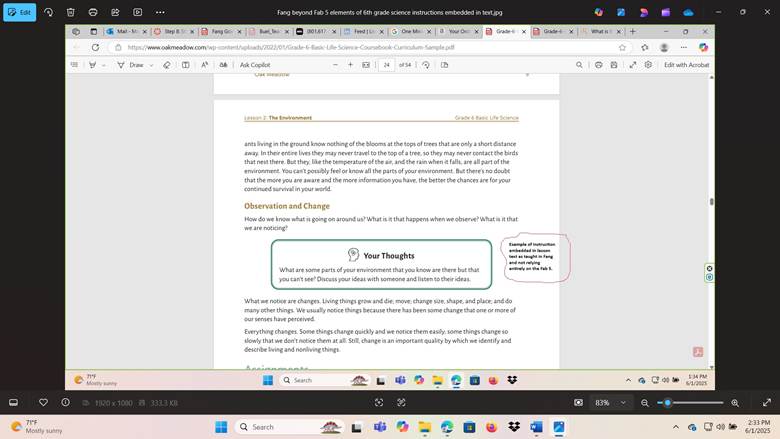
    Fang teaches an element of going beyond the Fab 5 for middle school literacy as instructions being embedded in test.

    In the English text reference, unlike the science reference below, I found the reading to be in a one-way direction with little, if any, questioning along the way.

    In the science text reference I did note a thoughts balloon embedded in the text which I interpret as a question along the reading.

    Buel’s Fundamental Comprehension

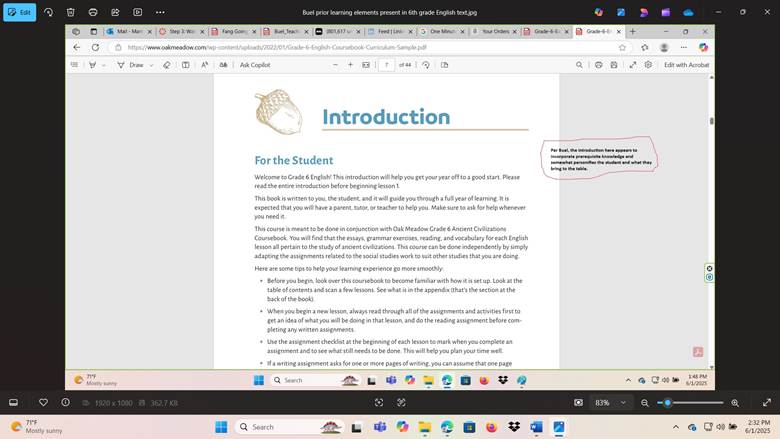
    Per Buel, a Fundamental Comprehension includes connections to prior learning.

    In the English text reference the English lesson text incorporated prior learning and prerequisites.

    In the science text reference, however, there appeared to be no mention of expected prior learning. The lesson seemed to dive right in without background.

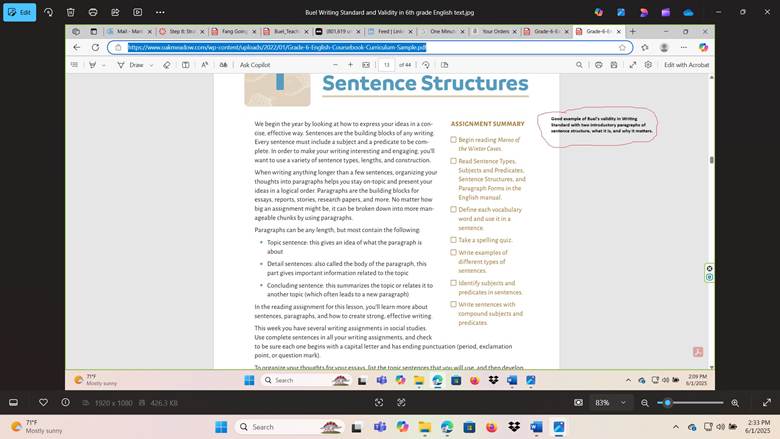
    Buel’s Writing Standard

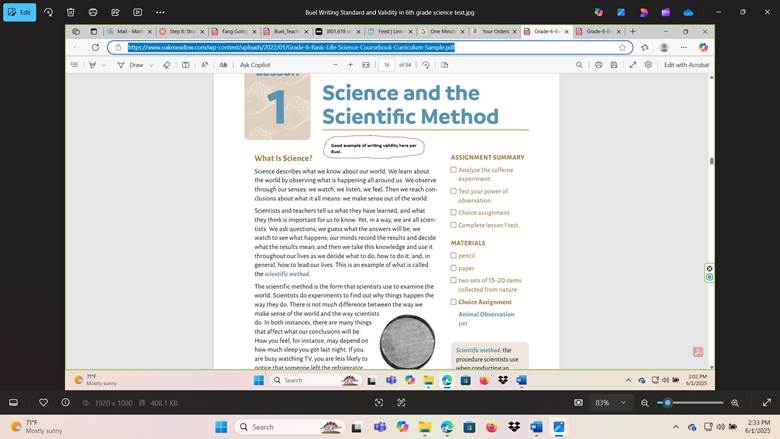
    As element of Buel’s Writing Standard includes validity.

    In the English text reference the two introductory paragraphs in Lesson One describe sentence structure, what it is, and why it matters.

    In the science text reference the introductions of science, scientists, and scientific theory appear to add validity for the student reader.

  • T.H.I.E.V.E.S. Strategy for Week Three in EDRD 619

    A strategy for my Module 2 assignment in Adolescent Literacy will apply the T.H.I.E.V.E.S. methodology to a 6th grade science lesson as found at ( https://www.oakmeadow.com/wp-content/uploads/2022/01/Grade-6-Basic-Life-Science-Coursebook-Curriculum-Sample.pdf ).

    The T.H.I.E.V.E.S. method involves structure of

    T – Title:

    Title suggests the text’s topic and promotes questions.

    H – Headings:

    Understand main ideas of sections and project content.

    I – Introduction:

    Overview of the chapter purpose.

    E – Every First Sentence:

    First sentence of each paragraph allows student to grasp the central idea.

    V – Visuals and Vocabulary:

    Visuals such as images, charts, and graphs; and vocabulary gather additional context.

    E – End-of-chapter questions:

    Summary questions to help students understand information.

    S – Summary:

    Students jot down their thoughts to form a general understanding of content.

    From Lesson One on page 1 ( https://www.oakmeadow.com/wp-content/uploads/2022/01/Grade-6-Basic-Life-Science-Coursebook-Curriculum-Sample.pdf ), there is indeed the title ‘Science and the Scientific Method.’ As for the Headings, there only appears to be one, ‘What is Science?’ I believe there to be room for expansion here with the headings, e.g., to incorporate ‘Scientific Method, ‘Scientists,’ and ‘Experimentation.’ The Introduction here appears to be the only Heading, ‘What is Science?’ which, I will argue, suffices with topics of science in the worldview and the work of scientists. Every First Sentence appears to fail here in that they do not seem to set an overall tone for the coming content. Rather, they appear to be hooks that run on from the prior paragraph. Visuals and Vocabulary with images microscopes, steaming coffee cups, and magnifying glasses. Indeed, there are End of Chapter Questions here. The Summary is an assessment matrix where students get to fill in X and Y points of topics, which I like.

    In conclusion, the 6th grade science text I references from https://www.oakmeadow.com/wp-content/uploads/2022/01/Grade-6-Basic-Life-Science-Coursebook-Curriculum-Sample.pdf had most of the T.H.I.E.V.E.S. components. The Headings and the Every First Sentence need work, in my opinion, to be considered part of the T.H.I.E.V.E.S. methodology.

  • Week Three in EDRD 619

    Beginning with the building blocks of word comprehension and language comprehension being foundational for reading comprehension according to studies this week, I learned about multiliteracy concepts in reading to include frameworks of situated practice, overt instruction, critical framing, and transformed practice (Alvermann, 2017). Situated practice considers real life experience of students and immerses them in cultural and linguistic diversity. Overt instruction is somewhat of a building block technique wherein teaches sponsor student growth incrementally. Critical framing takes global diversity into account via global economic integration and may consider mediums such as websites and blogs into addition to common text. Transformed practice re-creates activities for the learner, introducing a life experience scenario.
    Shifting gears a bit, I ended this week’s research asking the question how use of artificial intelligence will become a factor in multiliteracy environments.

  • Week Two of ERD619

    My studies this week exposed me to content-specific literacy. I used to be somewhat straight-forward in the writing styles I approached when putting ideas to paper. I would place format over subject and did not realize I was doing it until our studies this week.

                This week’s teachings enlightened me to consider specific subject area when preparing lesson content. For example, this week’s reading, Fisher and Frey (2020, pp. 6 – 7) proposed discipline-specific elements in text such as history being journalistic, science organized into introductory paragraphs, and English being narratives. Additionally, this week’s reading also taught in Dyches, Boyd, Baker, and Kaulfuss (2024, pg. 189) the Human Continuum comprises Critical Literacy and Disciplinary Literacy. This is the idea that students mature in their development of literacy skills.

                To conclude, this week’s lessons opened my eyes to subject-specific presentation in my writing preparations.

    references

    Dyches, J., Boyd, A.S., Baker, K., and Kaulfuss, A. (2024) POWER TOOLS 30 Critical Disciplinary Literacy Strategies for 6 – 12 Classroom, Myers Education Press, Gorham, Maine.

    Fisher, D. and Frey, N. (2020) Improving ADOLESCENT LITERACY Content Area Strategies at Work, Pearson, Fifth Edition, Hoboken, New Jersey.