Tag: reading

  • EDRD 619 Blog Module 3

    My research this week in Module 3 of a masters childhood literacy course involved teachings by Zhihui Fang and also teachings by Doug Buel. For the assignment I referenced a 6th grade science text found at https://www.oakmeadow.com/wp-content/uploads/2022/01/Grade-6-Basic-Life-Science-Coursebook-Curriculum-Sample.pdf and also a 6th grade English text found at https://www.oakmeadow.com/wp-content/uploads/2022/01/Grade-6-English-Coursebook-Curriculum-Sample.pdf.

    Fang’s Abstract

    Fang points out an abstract should comprise elements of discover, instruct, begin, reveal, and achieve.

    In the English text reference, there appeared to be elements of Begin and Instruct. I did not, however, notice anything that mapped to Reveal or Discover. This leads me to believe my 6th grade English text reference does not meet Fang’s abstract points.

    In the science text reference I discovered what could be interpreted as all elements in Fang’s abstract requirements.

    Fang’s Instruction Embedded in Text

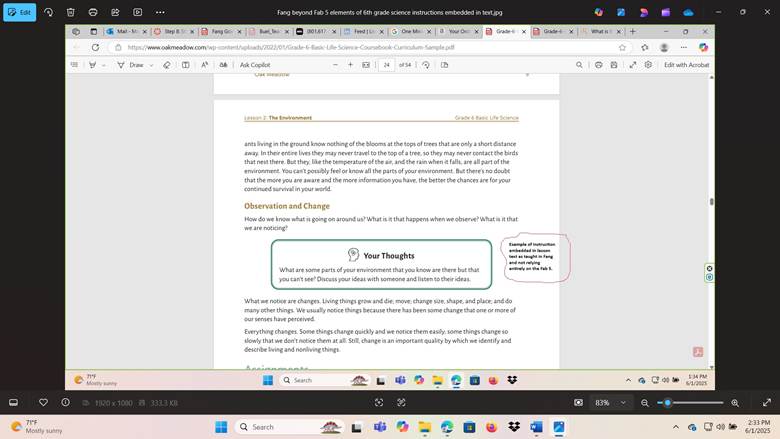
    Fang teaches an element of going beyond the Fab 5 for middle school literacy as instructions being embedded in test.

    In the English text reference, unlike the science reference below, I found the reading to be in a one-way direction with little, if any, questioning along the way.

    In the science text reference I did note a thoughts balloon embedded in the text which I interpret as a question along the reading.

    Buel’s Fundamental Comprehension

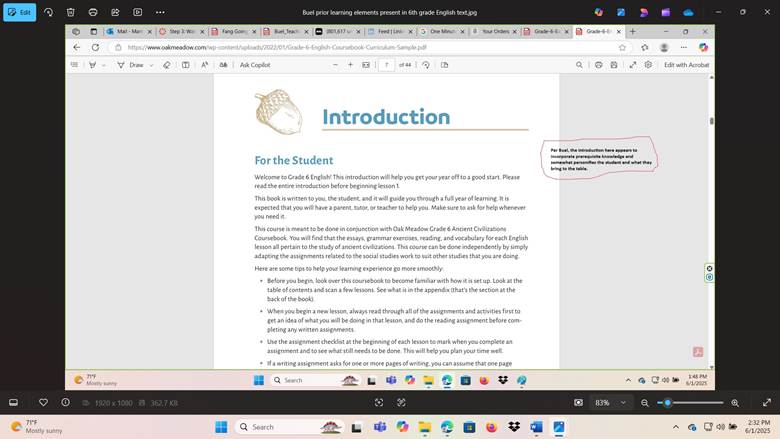
    Per Buel, a Fundamental Comprehension includes connections to prior learning.

    In the English text reference the English lesson text incorporated prior learning and prerequisites.

    In the science text reference, however, there appeared to be no mention of expected prior learning. The lesson seemed to dive right in without background.

    Buel’s Writing Standard

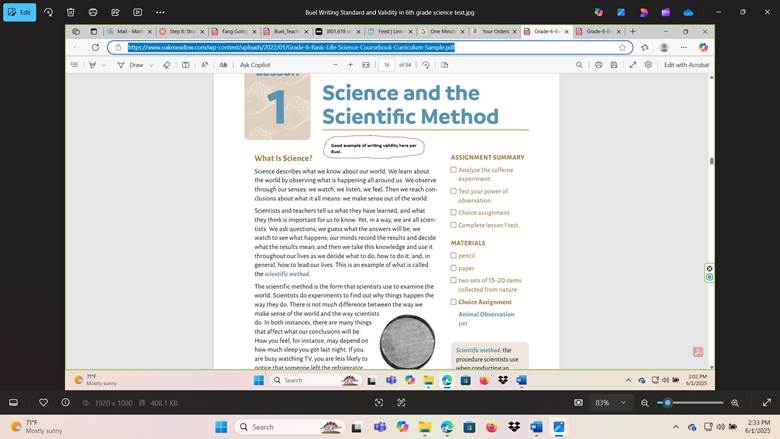
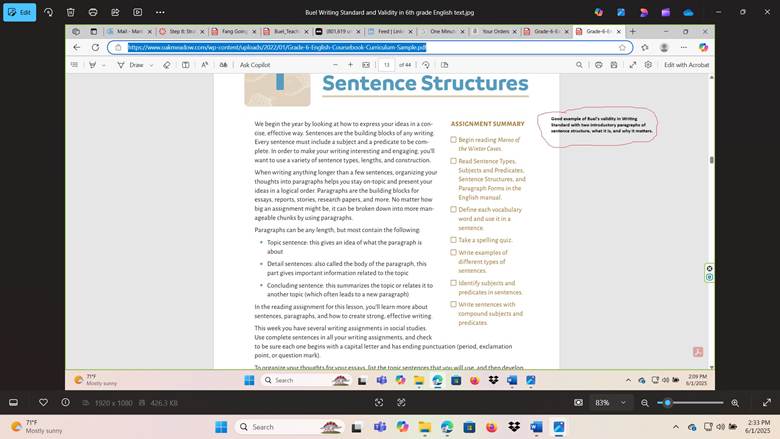
    As element of Buel’s Writing Standard includes validity.

    In the English text reference the two introductory paragraphs in Lesson One describe sentence structure, what it is, and why it matters.

    In the science text reference the introductions of science, scientists, and scientific theory appear to add validity for the student reader.

  • T.H.I.E.V.E.S. Strategy for Week Three in EDRD 619

    A strategy for my Module 2 assignment in Adolescent Literacy will apply the T.H.I.E.V.E.S. methodology to a 6th grade science lesson as found at ( https://www.oakmeadow.com/wp-content/uploads/2022/01/Grade-6-Basic-Life-Science-Coursebook-Curriculum-Sample.pdf ).

    The T.H.I.E.V.E.S. method involves structure of

    T – Title:

    Title suggests the text’s topic and promotes questions.

    H – Headings:

    Understand main ideas of sections and project content.

    I – Introduction:

    Overview of the chapter purpose.

    E – Every First Sentence:

    First sentence of each paragraph allows student to grasp the central idea.

    V – Visuals and Vocabulary:

    Visuals such as images, charts, and graphs; and vocabulary gather additional context.

    E – End-of-chapter questions:

    Summary questions to help students understand information.

    S – Summary:

    Students jot down their thoughts to form a general understanding of content.

    From Lesson One on page 1 ( https://www.oakmeadow.com/wp-content/uploads/2022/01/Grade-6-Basic-Life-Science-Coursebook-Curriculum-Sample.pdf ), there is indeed the title ‘Science and the Scientific Method.’ As for the Headings, there only appears to be one, ‘What is Science?’ I believe there to be room for expansion here with the headings, e.g., to incorporate ‘Scientific Method, ‘Scientists,’ and ‘Experimentation.’ The Introduction here appears to be the only Heading, ‘What is Science?’ which, I will argue, suffices with topics of science in the worldview and the work of scientists. Every First Sentence appears to fail here in that they do not seem to set an overall tone for the coming content. Rather, they appear to be hooks that run on from the prior paragraph. Visuals and Vocabulary with images microscopes, steaming coffee cups, and magnifying glasses. Indeed, there are End of Chapter Questions here. The Summary is an assessment matrix where students get to fill in X and Y points of topics, which I like.

    In conclusion, the 6th grade science text I references from https://www.oakmeadow.com/wp-content/uploads/2022/01/Grade-6-Basic-Life-Science-Coursebook-Curriculum-Sample.pdf had most of the T.H.I.E.V.E.S. components. The Headings and the Every First Sentence need work, in my opinion, to be considered part of the T.H.I.E.V.E.S. methodology.